Course / Course Details

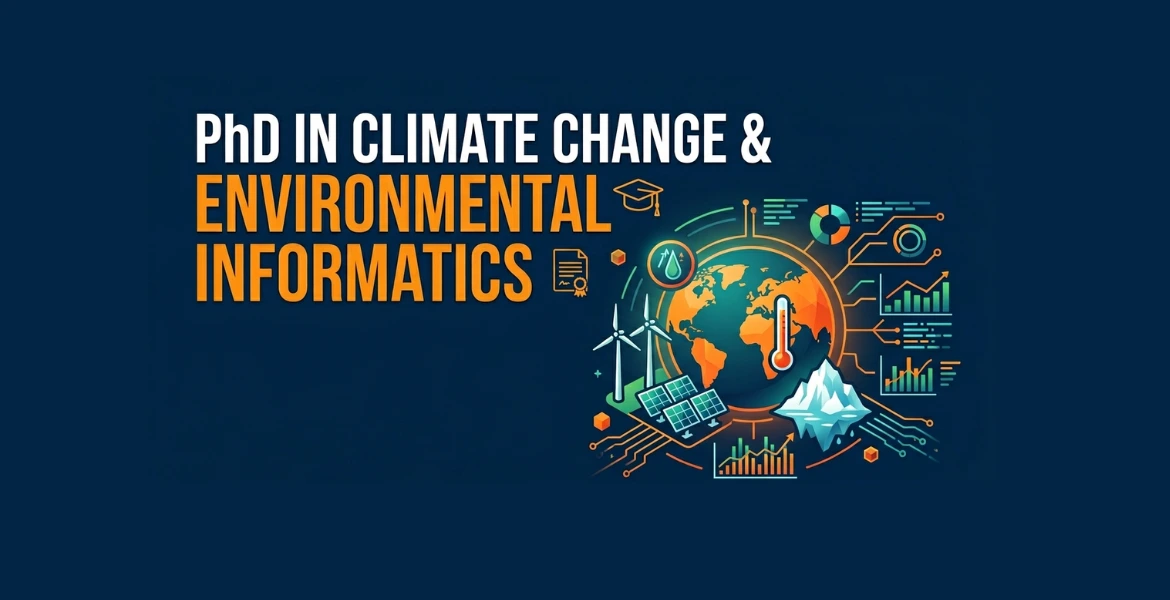
PhD in Climate Change and Environmental Informatics

  • Super admin image

    By - Super admin

  • 0 students
  • N/A
  • (0)

Course Requirements

  • A Master’s degree (Level 7 qualification or equivalent, 90–120 ECTS) in Environmental Sciences, Climate Science, Geography, Environmental Engineering, Computer Science, Data Science, Information Systems, GIS/Remote Sensing, Sustainability Studies, or related disciplines.
  • Strong academic research background demonstrated through a Master’s thesis, research publications, or equivalent scholarly work.
  • Submission of a detailed research proposal in Climate Change and Environmental Informatics.
  • Updated Curriculum Vitae (CV) highlighting academic and research experience.
  • Two academic or professional recommendation letters.
  • Proof of English language proficiency (IELTS, TOEFL, or equivalent), if applicable.
  • Interview or research proposal defense (as required by the institution).
  • Course Description

    The PhD in Climate Change and Environmental Informatics is a research-intensive doctoral program designed to address the complex environmental challenges of the 21st century through advanced data science, artificial intelligence, and environmental modeling.

    This interdisciplinary program integrates climate science, environmental studies, geoinformatics, remote sensing, and computational analytics to develop innovative solutions for climate change mitigation, adaptation, and environmental sustainability.

    Doctoral candidates engage in high-level independent research focused on understanding climate systems, analyzing environmental data, and developing intelligent models for predicting climate patterns, natural disasters, ecosystem changes, and environmental risks.

    The program emphasizes the use of modern technologies such as artificial intelligence, big data analytics, satellite imagery processing, GIS systems, and machine learning to support evidence-based environmental decision-making.

    Aligned with international doctoral research standards and European Higher Education Area (EHEA) principles, this PhD prepares graduates to contribute original scientific knowledge, influence environmental policy, and lead global sustainability initiatives.

    Graduates are equipped to work at the intersection of climate science, environmental technology, and digital innovation, addressing urgent global issues such as climate change, biodiversity loss, resource management, and sustainable development.

    Course Outcomes

    Upon successful completion of the PhD in Climate Change and Environmental Informatics, graduates will be able to:

    1. Conduct original, high-impact research that advances knowledge in climate change, environmental science, and informatics.
    2. Develop and apply advanced computational models for climate analysis, prediction, and environmental monitoring.
    3. Utilize artificial intelligence and machine learning techniques to analyze complex environmental and climate datasets.
    4. Integrate GIS and remote sensing technologies for spatial analysis of environmental and climate-related phenomena.
    5. Assess the impacts of climate change on ecosystems, biodiversity, natural resources, and human societies.
    6. Design data-driven frameworks for climate change mitigation and adaptation strategies.
    7. Analyze large-scale environmental datasets using statistical, computational, and geospatial methods.
    8. Contribute to scientific publications and peer-reviewed research in international journals and conferences.
    9. Communicate complex environmental findings effectively to academic, policy-making, and public audiences.
    10. Evaluate environmental policies and sustainability frameworks using evidence-based research methodologies.
    11. Develop interdisciplinary solutions combining environmental science, data analytics, and informatics.
    12. Lead research projects and collaborations with academic institutions, governments, and international organizations.
    13. Address ethical, social, and policy implications of climate change and environmental technologies.
    14. Innovate in the field of environmental informatics by developing new tools, models, and analytical systems.

    Course Curriculum

    • 0 chapters
    • 0 lectures
    • 0 quizzes
    • N/A total length
    Toggle all chapters

    Instructor

    Super admin

    As the Super Admin of our platform, I bring over a decade of experience in managing and leading digital transformation initiatives. My journey began in the tech industry as a developer, and I have since evolved into a strategic leader with a focus on innovation and operational excellence. I am passionate about leveraging technology to solve complex problems and drive organizational growth. Outside of work, I enjoy mentoring aspiring tech professionals and staying updated with the latest industry trends.

    0 Rating
    0 Reviews
    0 Students
    37 Courses

    Course Full Rating

    0

    Course Rating
    (0)
    (0)
    (0)
    (0)
    (0)

    No Review found

    Sign In or Sign Up as student to post a review

    Student Feedback

    Course you might like

    MS / MBA
    Master of Science (MS) in Climate Change and Environmental Informatics
    0 (0 Rating)
    The Master of Science (MS) in Climate Change and Environmental Informatics is an interdisciplinary graduate program desi...
    MS / MBA
    Master of Science (MS) in Climate Change and Disaster Management
    0 (0 Rating)
    The Master of Science (MS) in Climate Change and Disaster Management is an interdisciplinary graduate program designed t...

    You must be enrolled to ask a question

    More Courses by Author

    Discover Additional Learning Opportunities